


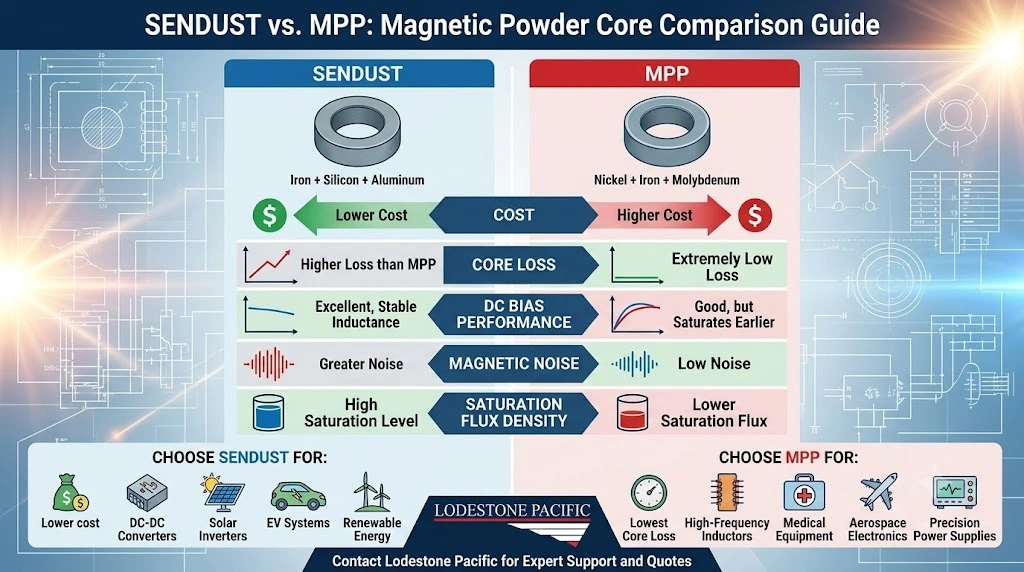
In 1936, a researcher named Hakaru Masumoto made a new magnetic alloy in Sendai, Japan. He built it as an alternative to permalloy. He named it after his city. Nearly a century later, Sendust is still one of the two go-to materials. Engineers reach for it most when picking a magnetic powder core. The other is MPP. The two get compared constantly, for good reason.
Magnetic powder cores are essential parts in transformers, inductors, filters, and power systems. They manage magnetic energy. They boost electrical output too, across countless designs. Sendust and MPP are both high-quality options. They’re just built for different jobs. Engineers weigh these two constantly. That’s true in power electronics, renewable energy gear, automotive electronics, and industrial equipment.
Lodestone Pacific supplies top-quality magnetic core materials for a wide range of uses. This guide breaks down Sendust vs. MPP clearly. That way, you can pick the right one for your next project.
What Are Magnetic Powder Cores?
Magnetic powder cores get made by pressing fine metal particles into a solid shape. Each particle carries an insulating coat first. Inductors and transformers use these cores widely. They manage magnetic fields well while keeping losses low.
Powder cores generally offer:
- Low core loss.
- Good energy storage.
- Stable performance.
- Reduced electrical noise (EMI).
- High efficiency.
Different materials bring different strengths to different jobs. That’s exactly why Sendust and MPP both still matter.
What Is Sendust?
Sendust is a powder core material made mainly of iron, silicon, and aluminum. A typical mix runs about 85% iron, 9% silicon, and 6% aluminum. Low cost and strong output explain why it shows up so often.
Sendust Strengths
- Low core loss.
- Excellent DC bias performance.
- Lower cost than MPP.
- High saturation flux density.
- Good thermal stability.
Where Sendust Shows Up
Sendust cores commonly appear in:
- Power inductors.
- Solar inverters.
- DC-DC converters.
- Industrial power supplies.
- Electric vehicle systems.
- Renewable energy gear.
The material performs well across medium- and high-frequency jobs.
Cost matters here. Sendust costs less than MPP. It still delivers strong output for most designs.
DC bias performance matters too. Inductance stays stable even under higher DC. That’s a real plus in a lot of power designs.
High saturation matters as well. Sendust can handle more magnetic flux before saturating. That lets engineers build smaller, more efficient parts.
Sendust isn’t perfect, though. In some high-frequency jobs, it runs a higher core loss than MPP. Some designs get louder too. For many jobs, neither drawback outweighs the real savings Sendust offers on cost.
What Is MPP?
MPP stands for Molypermalloy Powder. It’s made from nickel, iron, and molybdenum. A typical mix runs about 81% nickel, 17% iron, and 2% molybdenum. MPP’s output stays remarkably stable. Low core loss comes built into the material itself.
MPP Strengths
- Extremely low core loss.
- Excellent temperature stability.
- Low magnetic noise.
- High inductance stability.
- Excellent filtering output.
Where MPP Shows Up
MPP cores commonly appear in:
- High-frequency inductors.
- Medical equipment.
- Aerospace electronics.
- Military systems.
- Audio equipment.
- Precision power supplies.
These are all spots where steady, dependable behavior really matters.
Curious which material fits your specific design? Contact Lodestone Pacific’s engineering team. They’ll talk through your real application before you commit to a material.
MPP’s low core loss helps boost output while cutting heat. It also runs remarkably quiet. That’s exactly why sensitive electronics and audio systems lean on it. Good thermal stability across a wide temperature range rounds out the picture.
The tradeoff is cost. MPP’s makeup and build process cost more than Sendust. It also saturates earlier under very high flux. That can limit its use in some high-current designs.
The Real Numbers Behind Each Material
Specs matter more than general impressions once you’re actually designing around one of these materials.
| Property | Sendust | MPP |
| Makeup | ~85% Fe, 9% Si, 6% Al | ~81% Ni, 17% Fe, 2% Mo |
| Saturation flux density | Roughly 1.0-1.05 T | Roughly 0.7-0.75 T |
| Permeability range | 14 to 125 | 26 to 125 |
| Relative cost | Lower | Higher |
| Core loss | Higher than MPP | Lowest among powder cores |
These numbers explain the tradeoffs directly. Sendust’s higher saturation is exactly why it holds up better under high DC bias. There’s simply more headroom before the material saturates. MPP’s tighter, more refined makeup is what drives its lower core loss. That comes at the cost of that same headroom, though.
According to Magnetics Inc.’s own inductor core design guide, Sendust-type materials deliver DC bias output that’s genuinely close to MPP. That’s true in many real designs. It’s not just a distant second choice. The two materials solve overlapping problems in different ways. That’s exactly why picking between them depends so much on your specific job.
Sendust vs. MPP: Key Differences
| Factor | Sendust | MPP |
| Cost | More cost-effective | More expensive |
| Core loss | Slightly higher | Lower |
| DC bias performance | Strong, stable under high current | Excellent, but saturates earlier |
| Noise | Can run louder | Quieter operation |
| Best fit | Cost-sensitive power systems | High-precision, premium applications |
How to Choose the Right Material
The right pick depends on your application’s real needs and priorities.
Choose Sendust if you need:
- Lower material cost.
- Excellent DC bias performance.
- Strong saturation performance.
- Power electronics output.
- Renewable energy fit.
Choose MPP if you need:
- Very low core loss.
- Quiet operation.
- High-frequency stability.
- Precision output.
- Fit for sensitive electronics.
Before you lock in a final call, weigh other factors too. Operating temperature, frequency range, current levels, and budget all deserve real thought.
Why Material Selection Matters
Swap the magnetic core material, and the whole system changes. Output, efficiency, and reliability all shift with it.
Pick the wrong one, and you risk:
- Higher heat.
- Reduced efficiency.
- More electrical noise.
- Shorter product life.
- Poor overall performance.
Pick the right one, and reliability along with long-term output both improve.
Why Engineers Choose Lodestone Pacific
Lodestone Pacific supplies magnetic core solutions across a wide range of uses and industries.
Customers benefit from:
- High-quality materials.
- Engineering support.
- Reliable manufacturing.
- Competitive pricing.
- Global supply support.
- Custom component solutions.
That real experience helps engineers land on the right core material. This holds true for standard and custom jobs alike.
Ready to Specify Sendust or MPP? Get Real Support From Lodestone Pacific
Sendust and MPP are both widely used magnetic powder cores in modern electronics. Each brings distinct strengths depending on the job.
Sendust is often the better fit for cost-effective power systems. That’s especially true when strong DC bias output is needed. MPP suits high-frequency, low-noise jobs well. It’s the pick when excellent stability and the lowest possible core loss both matter.
Knowing how to tell these materials apart helps engineers build systems that perform better. They also run more efficiently and last longer.
Need high-quality magnetic powder cores or a custom magnetic component solution? Contact Lodestone Pacific’s team today. Request a quote for the right core material on your next design.
Frequently Asked Questions
- What is the magnetic powder core used for?
Transformers, inductors, filters, and power systems all use magnetic powder cores. They manage magnetic energy and boost output.
- What is the major difference between Sendust and MPP cores?
Sendust costs less and offers strong DC bias performance. MPP has lower core loss and operates more quietly.
- Which material works better for high-frequency jobs?
MPP tends to be the stronger pick for high-frequency work. Its very low core loss and strong stability explain why.
- Why do engineers choose Sendust for certain designs?
Sendust offers strong efficiency, high saturation output, and a lower price. That mix fits many power electronics jobs well.
- Why does MPP cost more than Sendust?
MPP’s nickel-based makeup and build process cost more. That investment delivers better low-loss and low-noise output in return.
- Does Lodestone Pacific offer custom magnetic core solutions?
Yes. Lodestone Pacific supplies magnetic powder cores and custom component solutions across numerous uses and industries.