


A five-cent plastic part can take down an entire product line. Skip it, and copper windings sit bare against a metal core. No insulation. No suzpport. Just a short circuit waiting to happen. That small part is the bobbin. It’s easy to overlook until it fails.
An E-core transformer bobbin is a molded plastic frame. It keeps windings organized, insulated, and mechanically supported. These parts show up in power supplies and industrial machines. They’re in medical devices, aircraft systems, and consumer electronics too. They quietly decide whether a build survives its first year or fails early.
Pick the right bobbin, and both performance and production get easier. This guide covers what E-core transformer bobbins are and how they work. It covers what engineers need to weigh before specifying one, too. At Lodestone Pacific, customers find a full range of bobbins. Custom magnetic component solutions round it out too, built for exactly this kind of decision.
What Is an E-Core Bobbin?
E-core transformer bobbins are molded plastic frames. They’re built to hold the copper windings of an E-core design. The job is simple to state. Organize the winding. Add insulation. Support clean assembly.
The bobbin keeps wire clean and separated from the metal core. It adds real electrical insulation and mechanical support too. Skip a bobbin, and winding gets harder to do consistently. It also gets a lot less safe.
How Does It Work?
Energy moves from one coil to another through a magnetic field. That’s the basic job of any transformer. The bobbin keeps those coils exactly where they need to be while that happens.
Copper winding goes onto the bobbin first. E-core pieces get inserted around it to complete the build. The bobbin handles several jobs at once:
- Holding the wire in place.
- Providing electrical insulation.
- Protecting the winding from damage.
- Simplifying assembly.
- Managing heat.
- Delivering mechanical support.
A well-chosen bobbin extends the life of the finished part. It extends the performance too.
Key Bobbin Components
Flanges: The side walls are called flanges. They keep wire from slipping out during winding.
Pins or Terminals: The circuit board mounts to these pins. The pins also anchor the winding wire. Placement varies by design.
Winding Area: This is the central section. Copper wire gets wound here to form the coils.
Insulation Barriers: Some designs include barriers. These keep one winding from touching another, adding a real layer of safety.
Temperature Ratings and IEC Classes
This is one thing engineers sometimes underweight. It deserves its own explanation.
Bobbin material doesn’t just need to survive normal use. It needs to hold up at the real hot-spot temperature. That’s true for the full service life. That’s what the IEC 60085 system measures. According to the International Electrotechnical Commission’s IEC 60085 standard, materials get sorted this way, into set classes. Each class is based on a max continuous temperature. That’s the highest heat a material can handle. It still needs to last a normal service life.
| IEC Thermal Class | Maximum Continuous Temperature |
| Class A | 105°C |
| Class E | 120°C |
| Class B | 130°C |
| Class F | 155°C |
| Class H | 180°C |
| Class N | 200°C |
Matching material class to real operating heat isn’t optional. A part rated below the real hot-spot will degrade early. That’s true no matter how good the rest of the design is.
Not sure which class fits your build? Contact Lodestone Pacific’s engineering team. They’ll walk through your heat needs before you pick a material.
Why Use a Bobbin
Easier Production: Bobbins simplify winding. That improves consistency and cuts build time.
Better Safety: Bobbins add critical insulation. That’s true between the winding, the core, and nearby parts.
Strong Support: A good bobbin keeps winding in place. That holds true under heat, vibration, and long-term use.
Better Winding Layout: Bobbins help keep even spacing between wires. That can meaningfully improve overall output.
Supports Automation: Many factories use automatic winding machines. Bobbins make that automation possible at scale.
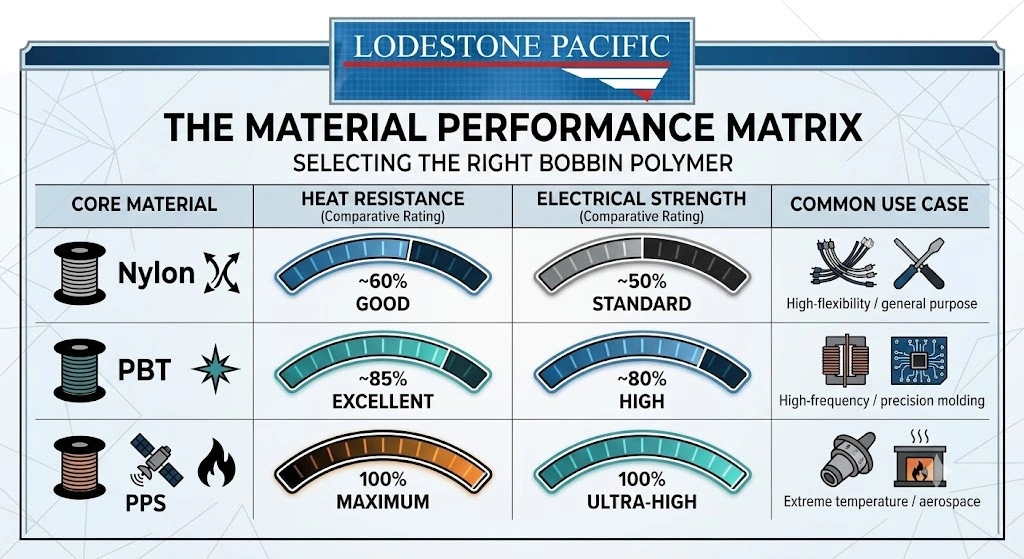
What Materials Are Used?
Most bobbins come from engineering plastics. Heat resistance and electrical strength drive that choice.
| Material | Typical Use Case | Key Property |
| Nylon | General-purpose, cost-sensitive designs | Good mechanical toughness |
| PBT | Higher-heat, dimensionally stable designs | Strong heat and moisture resistance |
| PPS | High-frequency, high-reliability builds | Excellent thermal and chemical resistance |
Each material earns its place for a reason. Heat resistance. Insulation. Strong support. A long service life under real-world use. Lodestone Pacific builds bobbins using quality materials picked for exactly these traits.
Where These Parts Show Up
Power Supplies: These handle voltage control. They handle isolation too, in many power designs.
Industrial Equipment: These parts show up throughout control systems. They’re in automation gear on the factory floor too.
Medical Devices: Medical electronics need parts that stay well insulated, safe, and reliable. Failure isn’t an option here.
Automotive Electronics: They support power systems and control units. That’s true in both conventional vehicles and EVs.
Consumer Electronics: These show up often in chargers and TVs. Gaming systems and home appliances use them too.
What to Consider When Choosing
Picking the right bobbin shapes both output and build efficiency.
- Core Size. Size and shape need to match the specific E-core it’s paired with.
- Heat Rating. Match the material’s thermal class to your real operating conditions.
- Pin Layout. The pin arrangement needs to line up with your PCB.
- Insulation Needs. High-voltage builds often need extra insulation barriers.
- Mounting Style. Some parts mount vertically, others horizontally.
- Production Needs. High-volume runs benefit from designs built for automated assembly.
Custom E-Core Transformer Bobbins
Standard parts aren’t right for every project. Special sizes and layouts often call for a custom-molded part instead.
Custom options can include:
- Special pin layouts.
- Custom shapes and sizes.
- Heat-resistant materials.
- Extra insulation spacing.
- Multiple winding sections.
Good design here can genuinely improve output. It can also make assembly easier downstream. Custom molding and engineering support are available through Lodestone Pacific. That covers special bobbin projects of any size.
Why Quality Matters
Low-quality parts tend to cause the same handful of problems, over and over:
- Weak insulation.
- Cracked plastic.
- Loose winding.
- Heat damage.
- Assembly problems.
Quality parts cut down on failure. They also improve long-term reliability. Material quality matters most for long-term output. So does build consistency.
Where Bobbin Design Is Headed
Electronics keep getting smaller and more demanding. Bobbin design keeps evolving to match. A few trends stand out:
- Smaller footprints.
- Better heat resistance.
- Improved insulation.
- Better support for high-frequency builds.
- Designs built around automated production from the start.
Makers keep finding better materials. They keep finding faster build methods too, to keep pace with these shifts.
Why Engineers Choose Lodestone Pacific
Lodestone Pacific has served this industry for decades. That’s more than 30 years now.
The company offers a full range of bobbins. Magnetic component solutions round out the lineup, across industries.
Customers benefit from:
- Quality materials.
- Custom molding support.
- Reliable manufacturing.
- Competitive pricing.
- Global supply support.
- Direct engineering help.
Engineers rely on that track record for both standard and custom design challenges. Quality, output, and manufacturability all stay intact along the way.
Get the Right Bobbin for Your Build
E-core transformer bobbins play a genuinely critical role. They shape safety, performance, and reliability. From winding support to insulation to assembly, they matter. They decide whether a design holds up in the field.
The right choice improves build efficiency. It strengthens electrical output. It extends product life too. Weigh material, insulation class, heat rating, and mounting style carefully. Do this before you commit to a part number.
Lodestone Pacific can help. That’s true whether you need standard bobbins or a fully custom design. Contact our team today to request a quote and get real engineering input before your next production run.
Frequently Asked Questions
- What is a bobbin for an E-core transformer?
An E-core transformer bobbin is a plastic frame. It surrounds the copper windings in a transformer. It keeps them organized and insulated from the core.
- Why are transformer bobbins important?
They improve safety and support the winding. They also make assembly easier. Reliability and performance both improve too.
- What raw materials are used for E-core transformer bobbins?
Most get made from engineering plastics like nylon, PBT, or PPS. These get picked for strong insulation and heat resistance.
- Can E-core transformer bobbins be custom-made?
Yes. Lodestone Pacific can design and build custom bobbins. That covers special sizes, pin layouts, insulation needs, and more.
- What industries use E-core transformer bobbins?
Common uses include industrial electronics, automotive systems, medical devices, telecom, renewable energy gear, and consumer electronics.
- How do I pick the right transformer bobbin?
Consider core size, heat rating, mounting style, and insulation needs. Factor in PCB pin layout and production volume too.