The current electronic design is not just concerned with the performance of the components, but also their location and placement in a system. Toroidal transformers and inductors are significant components that are utilized in numerous applications, such as power supplies and industrial electronics. But there is one major consideration, which is frequently forgotten–how these components are wired to printed circuit boards (PCBs). Here is where Toroid Mounting Solutions are critical.
However, one factor that is often overlooked is how these components are mounted to printed circuit boards (PCBs), which is where toroid mounting solutions play an important role.
One of the questions that engineers are frequently asked is whether they should do vertical or horizontal mounting. There are advantages and disadvantages to the two options. This paper describes all the ways and assists you in selecting the most appropriate option for your demands.
Toroid Mounting Solutions: What are they?
Toroid mounting solutions are employed to securely mount toroidal components, e.g., transformers and inductors, on PCBs. These solutions offer physical assistance and an electrical connection between the component and the circuit.
Toroidal components contain a core that is in the form of a ring. They are widely used because of their high efficiency, compact size, and low electromagnetic interference (EMI). But they are also more difficult to mount, due to their shape.
Without proper mounting, toroidal components can shift during operation, transportation, or assembly, potentially affecting performance and reliability.
Good toroid mounting solutions can assist in:
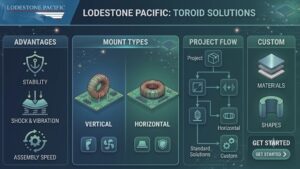
- Keep components stable
- Lessen vibration and shock losses.
- Assist in quick and effective assembly.
- Maintain long-term reliability
Due to this, the selection of an appropriate mounting solution is quite crucial to the performance of the product and the success of manufacturing.
Companies like Lodestone Pacific offer a wide range of Toroid Mounting Solutions designed for modern PCB integration.
Mounting Configurations: Total Overview
Toroid mounting solutions are of two major types: vertical mounting and horizontal mounting. The toroid is positioned in various locations on the PCB by each method.
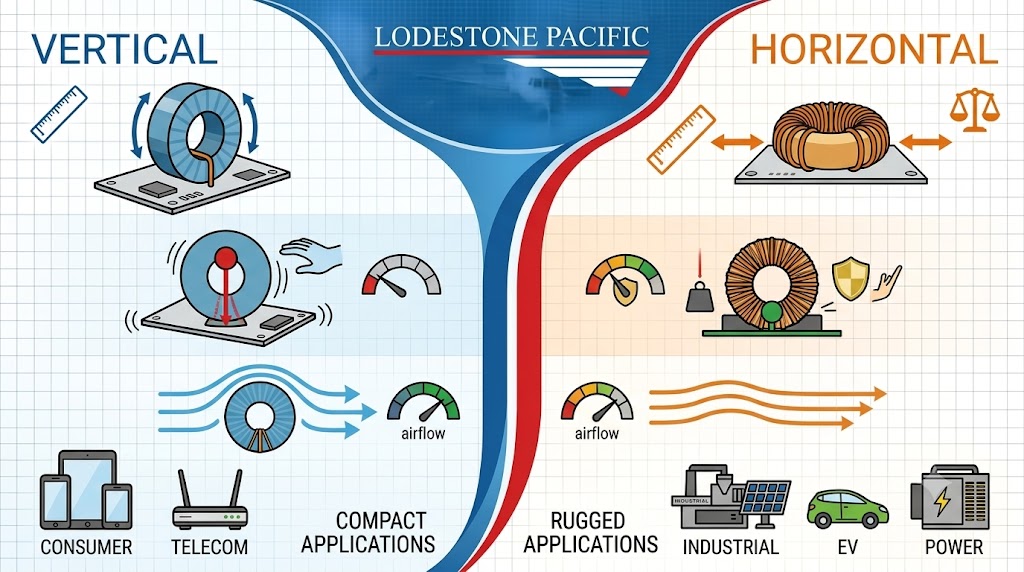
- Vertical mounting has the toroid standing on end.
- The horizontal mounting is flat on the board.
Both of them are popular and have various advantages.
There are even newer technologies like surface-mount technology (SMT), which facilitate automated production. But in most designs, vertical and horizontal mounting are still most often used. Their operation will be explained, and this will assist you in making a better choice.
What exactly are Horizontal Toroid Mounting Solutions?
Core Features
Horizontal mounting is where the toroid flat is in contact with the PCB, distributing weight evenly and providing a low center of gravity.
What are the Pros?
The primary advantage of horizontal mounting is mechanical stability. The component sits close to the PCB surface and makes it more able to withstand vibration, shock, and movement.
This mounting is well-suited for environments that require long-term durability and reliability. Moreover, it is able to simplify assembly since the component automatically remains on the PCB.
What are some of the Cons?
However, it comes with many limitations. A common issue with the Horizontal Mounting is the bigger PCB footprint that comes bundled with it. This will certainly limit compact flexibility. The balance between the stability and constraint aspects is to be adhered to.
Best Usage Cases
Horizontal toroid mounting solutions can be used in:
- Industrial equipment
- Power electronics
- Automotive systems
They are best suited for places where stability and longevity are of utmost importance.
What are Vertical Toroid Mounting Solutions?
Key Features
With vertical mounting, the toroid is positioned upright, reducing the amount of PCB surface area required.
What advantages does it offer?
The primary benefit of vertical mounting is space efficiency. By reducing the PCB footprint, designers can accommodate additional components or create more compact products.
It can also help in working with larger toroids and in any case where there is ample space vertically. In certain instances, this arrangement may enhance good air circulation in the area of the component, a factor that aids in cooling.
What are some of its limitations?
Horizontal mounting is more stable than vertical mounting. Since the component is in a higher position, it has a higher centre of gravity. This renders it more vibration- and mechanical-stress-sensitive. In the long run, this may result in wear or damage.
Best Suited Applications
Vertical toroid mounting solutions are most suitable for:
- Consumer electronics
- Telecommunications devices
- Compact power supplies
They can be utilized in steady places where space-saving is a concern.
Vertical vs. Horizontal: What are the Key Differences?
Both mounting methods offer distinct advantages, and the best choice depends on the application’s requirements.
Vertical installation is most suitable for saving space. It aids designers in adding additional items to a PCB. Nonetheless, it might not be as resistant to extreme conditions.
Horizontal mounting, in turn, is more stable and durable. It will be more stable when there is vibration or movement, but it occupies more space.
Both of them can be used with automated systems in terms of manufacturing. Nonetheless, horizontal mounting could be a little easier to manipulate in the process of assembly.
However, ultimately, there is no optimal decision. The optimal decision will be made based on your design objectives, workspace constraints, and work environment.
Core Factors to Look Out for during the decision-making process
In selecting the appropriate toroid mounting solution, there are various aspects to be taken into consideration.
To begin with, consider the operating environment. Horizontal mounting is generally preferable should your product be subjected to vibration, heat, or mechanical forces.
Second, take into account the PCB space available. In case there is a lack of space, it can only be mounted vertically.
Other important factors include:
- The size and weight of the toroid.
- The form of the manufacturing process.
- Price and quantity of production.
Manufacturers such as Lodestone Pacific provide both standard and custom toroid mounting. This would enable engineers to compromise in the best way in terms of performance and production requirements.
What Role Do Customisations Contribute to Modern Designs?
With the increasing sophistication of electronic systems, custom solutions are becoming increasingly popular. Off-the-shelf products do not necessarily satisfy the specialised uses, such as renewable energy or high-performance computing.
Tailored toroid mounting designs enable the engineer to customise:
- Design and shape
- Materials used
- Thermal performance
Such as, tougher materials can enhance durability, and tailored designs can save assembly time and improve efficiency.
Companies such as Lodestone Pacific offer engineering services and rapid prototyping. This aids in providing assurance that the result will be designed to satisfy certain design specifications.
What are the Industry Applications of Toroid Mounting Solutions?
The toroid mounting solutions are used across a wide range of industries where reliable power conversion and signal conditioning are essential.
They are used in power supply systems to make it stable and efficient. They facilitate reliability in the long term in renewable energy systems, including solar inverters.
Components used in automotive electronics have to withstand continuous vibrations and temperature variations. Strong mounting solutions are also required to ensure that industrial machines operate well.
These instances demonstrate the significance of selecting the appropriate mounting technique depending on the environment and use.
What are the Future Implications for Toroid Mounting Solutions?
Selecting the right toroid mounting solution is about more than securing a component to a PCB. It directly affects reliability, manufacturability, thermal performance, and long-term product durability.
With the ever-increasing complexity of electronic systems, the demand for mounting solutions that are reliable and efficient will also rise. Both vertical and horizontal mounts will remain valuable design options. The optimal choice depends on available space, environmental conditions, manufacturing requirements, and overall system objectives.
Find the Right Toroid Mounting Solution for Your PCB Design
The experienced manufacturers, such as Lodestone Pacific, will also be significant as they will offer high-quality and tailor-made solutions. Finally, the right Toroid Mounting Solutions assist in enhancing performance, enabling effective manufacturing, and making it long-term reliable.
Explore Lodestone Pacific’s Toroid Mounting Solutions today to find the right solution for your design.
Frequently Asked Questions
- What is the application of Toroid Mounting Solutions?
Toroid Mounting Solutions are solutions that are used in securing the attachment of the toroidal components, including transformers and inductors, to the printed circuit boards (PCBs). They will assist in maintaining the components unchanged and in ensuring that the electrical connections are duly taken care of.
- Which is better: vertical or horizontal toroid mounting?
There is no single best choice.
- Vertical mounting is more suitable for saving space.
- Horizontal mounting gives the benefit of stability and longevity.
The correct decision will be based on your design and workplace environment.
- Do the Toroid Mounting Solutions have compatibility with automated manufacturing?
Yes, they do. An effective mounting solution enhances:
- Stability
- Heat management
- Long-term reliability
Munting may be damaged or perform poorly due to poor mounting.
- Can Toroid Mounting Solutions be customized?
Yes. Custom solutions are available from many manufacturers (Lodestone Pacific, among others). They can be made to suit your particular size, material, and performance requirements.
- Are the Toroid Mounting Solutions compatible with automated manufacturing processes?
Yes. A great deal of current mounting systems are intended to be used in conjunction with automated assembly systems, such as surface-mount technologies (SMT).