


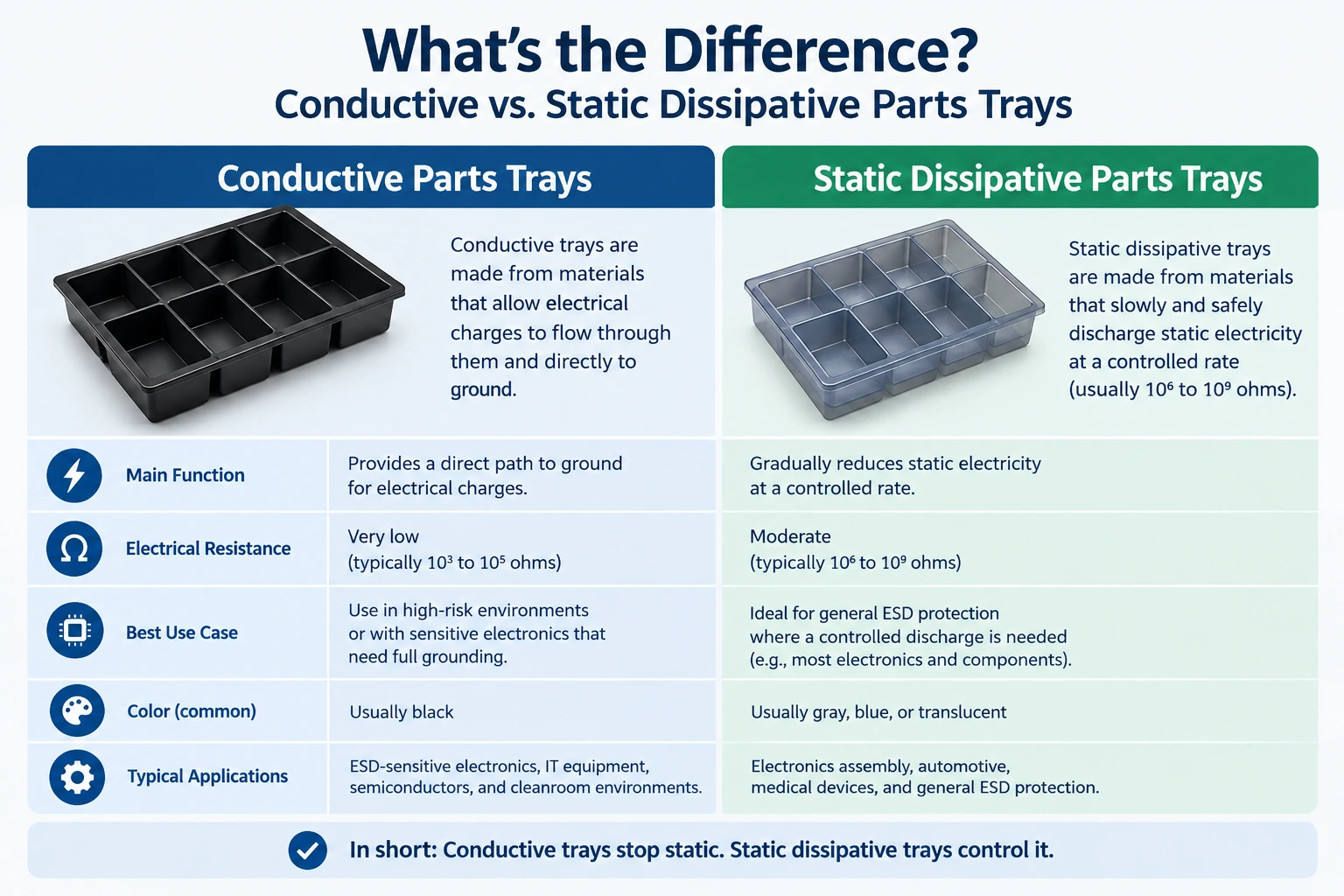
You will not feel a static shock until it reaches about 3,000 to 4,000 volts. Yet many electronic devices can be damaged at less than 100 volts. That gap is why a part can look fine on your bench and still fail weeks later in the field.
Trays are one of your first lines of defense. Two types dominate electronics plants: conductive parts trays and static dissipative trays. Both control static, but they do it in different ways. This guide explains the difference so you can match the right tray to each step of your line.
If you need a place to start, Lodestone Pacific offers anti-static parts trays for handling and shipping electronic components.
Why ESD Protection Matters in Electronics
Electronic parts are very sensitive to static electricity. A person walking across a floor or touching a plastic surface can build up a charge. When that charge jumps to a chip or PCB, it is called electrostatic discharge, or ESD.
The worst part is that the damage is often hidden. A part can pass inspection, then fail during testing or in use. According to Assembly Magazine, up to 25 percent of all electronic product failures can be traced to ESD. The same article notes that more than 75 percent of ESD comes from the human body. It also says latent defects are hard to find without an electron microscope.
That means waste, delays, and higher costs. This is why plants use ESD-safe trays, bags, and containers for storage, handling, and shipping.
What Are Conductive Parts Trays?
Conductive parts trays are made from materials that carry electricity. Static charge does not stay on the surface. It moves through the tray and drains away.
These trays are often made from carbon-filled plastic. They have very low electrical resistance, so charge leaves fast. That makes them a strong choice where ESD control must be tight, such as:
- Semiconductor manufacturing
- PCB assembly lines
- Sensitive chip handling
- Automated electronic production systems
There is one catch. Fast discharge can create a short, high-current event if a sensitive part touches the tray without good controls in place. A conductive tray works best when it is grounded, and the system around it is well designed.
What Are Static Dissipative Trays?
Static dissipative trays have higher electrical resistance than conductive trays. This controlled flow will decrease abrupt discharge, which might be safer for some components.
You will often see them in:
- General electronics assembly
- Storage areas
- Transport packaging
- Mixed component environments
They offer solid protection; they are easy to use, and they suit most factory settings.
Conductive vs. Static Dissipative Trays: Key Differences
The main difference is how fast each tray moves charge. Conductive trays move it very fast. Static dissipative trays move it slowly and with more control.
| Feature | Conductive trays | Static dissipative trays |
| Surface resistance | Below about 1 x 10^4 ohms | 1 x 10^4 to below 1 x 10^11 ohms |
| Discharge speed | Fast | Slow and controlled |
| Grounding need | High, since fast discharge needs a safe path | Still advised, but less sensitive to setup |
| Common materials | Carbon-filled polymers, conductive ABS | Static dissipative polypropylene, ESD-grade blends |
| Best for | Very sensitive chips and semiconductors | Mixed parts, storage, and shipping |
| Watch out for | Hard discharge if controls are poor | May be too slow for the most sensitive parts |
The resistance ranges above follow common industry definitions, as summarized by Desco. The dissipative range is set in ANSI/ESD S541. Exact limits can vary by test method, so check your own ESD control program.
Which One Should You Choose?
The right tray depends on your parts and your process.
Choose conductive trays for very sensitive chips or semiconductors. They remove static fast and lower risk on fast lines.
Choose static dissipative trays for mixed parts or general protection. They tolerate a wider range of parts and conditions.
Most plants use both. The table below shows a common way to split them by stage.
| Production stage | Typical tray choice | Why it fits |
| Incoming storage | Static dissipative | Slow, safe charge control for mixed parts |
| Clean room handling | Conductive | Fast drain for high-sensitivity parts |
| Automated pick and place | Conductive or custom cavity | Tight control and steady part position |
| Internal transport | Static dissipative | Stable protection with less setup |
| Shipping | Static dissipative | Easy, tolerant packaging |
Not sure which tray fits your line? Request a sample tray from Lodestone Pacific and test the fit with your own parts before you place a full order.
How to Check That Your Trays Are Working
A tray only protects parts if it keeps doing its job. Wear, dirt, and damage can change how a tray behaves. A simple check routine keeps you safe.
Start with surface resistance. ANSI/ESD STM11.11 is the ESD Association method for measuring surface resistance of flat materials. Measure a few trays from each lot and compare the results with the ranges in the table above.
Then look at the setup around the tray. Work surfaces, floors, and operators also need to be grounded. Static control only works when the whole path is sound.
Finally, build a schedule into your ESD control program. Check trays when they arrive, after cleaning, and after rough handling. Take any tray out of use if it is cracked, worn, or reads outside your limits.
Material Types Used in ESD Trays
Both tray types rely on special materials that control how electricity moves across the surface. Common choices include:
- Carbon-filled polymers
- Conductive ABS plastic
- Static dissipative polypropylene
- Special ESD-grade blends
Strength, durability, and cost vary with each one. The best choice depends on how the tray will be used.
Tray Design Matters Too
ESD trays are not only about material. Design plays a big role in how well they perform.
A good tray design helps you:
- Hold parts in place
- Reduce movement during transport
- Improve automation handling
- Speed up the production line
Lodestone Pacific’s standard tray measures 8.75 x 11.75 inches, with cavity counts that range from 35 up to 280 depending on the part size. The trays nest when empty and stack when full, which protects parts in each cavity.
They are a good fit for wound parts such as the magnetic components used in transformers and inductors, where terminals need protection during winding and transport. If your part is unusual, custom cavity sizes and fully custom trays are available.
Cost vs. Performance
Tray price depends on the material, the cavity design, and the order size. Price alone should not drive the choice.
A single failed component can cost far more than a tray. The right tray is a long-term investment in yield and quality. Many companies also blend both types based on the risk level of each product.
Why ESD Control Matters More Today
Modern electronics are smaller, faster, and more sensitive than ever. That makes ESD control more important at every stage of production.
Conductive and static dissipative trays both help cut failure rates, improve quality control, and support automation. As smart manufacturing grows, ESD-safe packaging will only matter more.
Protect Your Parts From Start to Finish: Request a Quote on ESD Trays
Knowing the difference between conductive and static dissipative trays helps you protect the right parts in the right way. Conductive trays give fast discharge for high-sensitivity parts. Static dissipative trays give controlled, balanced protection for general use. The best pick depends on your product, your process, and your risk.
Ready to protect your components? Request a quote from Lodestone Pacific for ESD parts trays that fit your parts, your line, and your resistance requirements.
FAQs: Conductive vs. Static Dissipative Parts Trays
- What is a conductive parts tray?
It is a tray made from conductive material, often carbon-filled plastic. It moves static charge away from parts fast, which suits very sensitive chips.
- What is a static dissipative tray?
It is a tray that releases static charge slowly and in a controlled way. This lowers the risk of a sudden discharge and suits general handling and storage.
- Which is better, a conductive or a static dissipative tray?
Neither is better in every case. Conductive trays suit very sensitive parts, while static dissipative trays suit mixed parts, storage, and shipping.
- Do conductive trays need to be grounded?
Yes. Fast discharge needs a safe path, so ground the tray and the work area around it. Without good grounding, a conductive tray can lose its benefit.
- What resistance range defines each tray type?
Conductive materials fall below about 1 x 10^4 ohms. Static dissipative materials fall from 1 x 10^4 up to below 1 x 10^11 ohms.
- Can I use both tray types in one factory?
Yes, and many plants do. Conductive trays often serve clean, high-sensitivity areas. Static dissipative trays often handle storage and transport.